
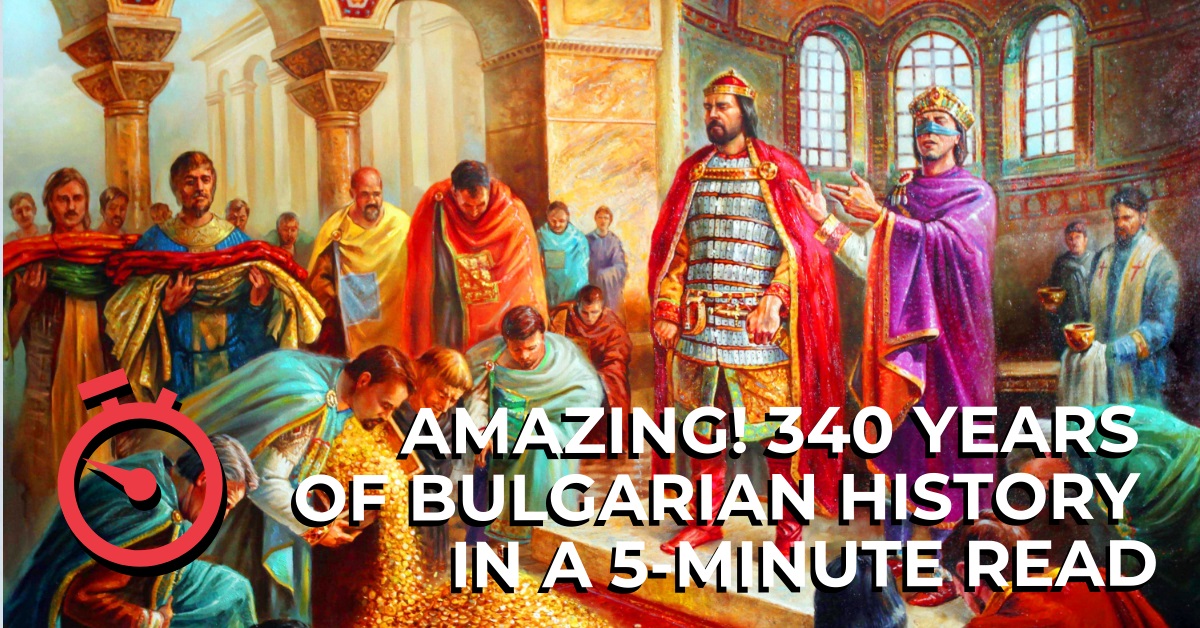
We can divide the Bulgarian history into 5 main periods:
- Prehistory
- Antiquity
- The Middle Ages
- Ottoman ruling
- Contemporary history
We are about to get familiarized with the founding of Bulgaria – where, when, and under what conditions. Let’s go even further back in time, all the way to …
The Migration Period in Europe
The Migration Period (IV-VII century) was a period in the history of Europe when widespread migration of and invasions by peoples occurred. This causes great political, demographic, and cultural changes on the Balkan Peninsula, which changed the world there forever.
Here is some of the first information about the Bulgarian tribes in these lands:
In 479, the Byzantine emperor Zeno was forced to ally for the first time with the proto-Bulgarians who lived between Constantinople and the Adriatic coast.
In 499, Arist, the commander of the Illyrian troops, with fifty thousand armed troops and 250 cars, loaded with the necessary equipment for battle, marched against the Bulgarians. In the battle, the proto-Bulgarians destroyed more than four thousand Romans! Later, in 501, the tribe of Bulgarians invaded Illyricum1 and Thrace2.
Historical Dictionary:
- Illyricum is a Roman province that roughly corresponds to modern-day northern Albania, Montenegro, Bosnia and Herzegovina, and coastal Croatia.
- Thrace is a geographical and historical region in Southeast Europe. It consists of Southeastern Bulgaria (Northern Thrace), northeastern Greece (Western Thrace), and the European part of Turkey (Eastern Thrace).
Thus, by the 5th century, the proto-Bulgarian community was divided into two quite distant areas:
- The lands north of the Caucasus
- The Black Sea and the region of Pannonia (Middle Danube)
The Slavs also play a key role in Bulgarian history. After the disintegration of the Hun state (453), they began to pass through passages in the Carpathians and settled in Transylvania in the second half of the 5th century.
A few years later, in 488, the Slavs occupied areas along with the Lower and Middle Danube. The first Slavic invasion across the Danube was recorded in history in 519 during the reign of Emperor Justin I. In the 6th century, the Slavs began to settle south of the Danube in the Balkan lands.
By the middle of the 7th century, the southern Slavs managed to conquer vast territories of the peninsula and became the dominant population of the Balkan Peninsula.

To resist the growing Byzantine pressure, as well as to undertake some more significant military actions, proto-Bulgarians and Slavs began to organize in military-tribal alliances. One of them puts down the roots of the future Bulgarian state, namely…
Old Great Bulgaria
In 632 some of the proto-Bulgarians created a large military-tribal union – Old Great Bulgaria. Its capital is believed to be the city of Phanagoria, located on the Taman Peninsula3.
Historical Dictionary:
3. The Taman Peninsula is a peninsula in the present-day Krasnodar Territory of Russia, bordering the Sea of Azov to the north, the Kerch Strait to the west and the Black Sea to the south.
According to the sources, after the conclusion of an alliance with the Byzantine emperor Heraclius in 635, the proto-Bulgarian state was recognized and its ruler Kubrat received the honorary title of “patrician”.

Old Great Bulgaria existed for about 30 years, from 632 to about 668. Khan Kubrat was a successful ruler and built a strong country, but after his death, the country entered a crisis.
His three sons were faced with the fateful decision of how to protect the proto-Bulgarians from enemy tribes. That’s why in the second half of the 7th century, the last significant division of the Bulgarian ethnic group was reached:
- Kubrat’s eldest son – Batbayan remained within the borders of Old Great Bulgaria. After military attempts to oppose the Khazars, he was forced to obey them.
- Kotrag, the second son, settled down between the rivers Volga and Kama with the tribe Kotragi. Volga-Kama Bulgaria was established there in the 10th century.
- Khan Kubrat’s third son, Asparuh, along with the Onogondurs, headed west. He crossed the Dnieper and Dniester rivers and settled in the Ongala4 region, today’s Bessarabia. He laid the foundations of the country you are currently in (or will one day visit).
Historical Dictionary:
4. The most common version is that Ongala is a fortified camp with an area of 48 km2, discovered by archaeologists near the village of Nikulitsa (near Tulcea, Northern Dobrudja). Another version places Ongala in the Galati area, by the Seret River. Some scholars believe that Ongala was in present-day Bessarabia.
Proto-Bulgarian attacks and the campaign of Constantine IV
After the disintegration of Greater Bulgaria, the three sons of Khan Kubrat separated and each went his own way.
We will continue our adventure through history with the youngest brother – Khan Asparuh.
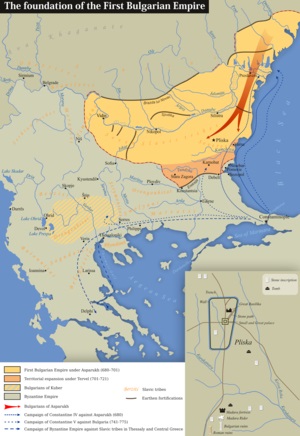
He, together with his part of the proto-Bulgarian tribe, moved to the Balkan Peninsula and merged with the Slavs, who came from the north in the early VI century.
The great migration of peoples mixed many tribes on the Balkan Peninsula. This was a threat to the Byzantine Empire (Eastern Ancient Rome).
Frequent attacks by Goths, Huns, Avars, Slavs, and Proto-Bulgarians weakened the defensive potential of its Byzantine provinces. But the biggest problem was the attacks carried out by the proto-Bulgarians in Dobrogea.
In the summer of 680, Constantine IV, the emperor of Byzantium, attacked the Bulgarians by land and sea. The huge Byzantine army gathered in Ongala and along the Danube.
Suddenly, Constantine IV left the battlefield under the pretext that he was ill and went to Mesembria for treatment. His departure was assumed as an escape by his troops and they panicked. Khan Asparuh took advantage of the situation and inflicted a heavy defeat on the Byzantine army.
The battle ended with a spectacular victory for the proto-Bulgarians. They did not linger for a moment and crossed the Danube, where they conquered the lands up to the Balkan Mountains.
As a result of this agreement, in the autumn of 680, Khan Asparuh built a military-political alliance with the Moesian Slavs, directed against Byzantium, Avar, and Khazaria, and with this act, the new Bulgarian state was created.
The union between proto-Bulgarians and Slavs
After this success of the proto-Bulgarians, they crossed the Danube and invaded Northeastern Bulgaria. There they conquered many Byzantine lands to Stara Planina.
They subjugated the local Slavic tribes and concluded an alliance agreement with their princes for joint actions and defense of the conquered territory. Proto-Bulgarians and Slavs began to live together in peace.
These were the first steps of Khan Asparuh towards the creation of a common political union – the basis of the new Bulgarian state.
Formation of the Bulgarian state
In the following year (681) the proto-Bulgarian cavalry undertook attacks south of the Balkan Mountains, in the region of Thrace.
Not having enough military forces to successfully resist, Constantine IV was forced to conclude a peace treaty with Khan Asparuh. 681 became the year of the establishment of Danube Bulgaria.
According to the treaty, the emperor recognized the conquered lands and undertook to pay an annual tax to Khan Asparuh. Byzantium legally recognized the existence of the new Bulgarian state in the Balkans and Bulgaria gained legitimacy in interstate relations.

Khan Aparuh
The new country was organized administratively on the military proto-Bulgarian principle with fortified cities (villages). Pliska had been chosen for capital.
The creation, strengthening, and preservation of the young Bulgarian state was carried out through the successful cooperation between proto-Bulgarians and Slavs and the local Thracian population.
All three tribes preserved their traditions and culture. They were united by a common interest in protection from external enemies – Byzantium, the Avar Khaganate, and the Khazars. The Thracians contributed to the new state with their developed urban way of life and their exceptional craft skills.
The proto-Bulgarians played a leading role in the newly formed state. Pliska, the capital of Danube Bulgaria, was transformed from an ordinary military camp into a medieval fortress. The khan and the tribal aristocracy are at the head of the highest state posts and direct the actions of the army composed of proto-Bulgarians and Slavs.
So, we won! Bulgaria is officially a thing. Now, let’s see what will happen next…
The reign of Khan Tervel

In 701 Khan Tervel ascended the Bulgarian throne. He comes from the same genus Dulo and is probably the son of Asparuh. The reign of Khan Tervel is connected with the establishment of the Bulgarian state and the outlining of some important tendencies in politics, which will find development in his successors as well. The state talent and political acumen of Khan Tervel ensured that Bulgaria maintained its territorial integrity, as well as to receive its first expansion.
Khan Tervel helped the Byzantine emperor Justinian II regain power and control the political crisis in Byzantium, which began in 695. As a token of gratitude, the emperor awarded the Bulgarian ruler the title of “Caesar” and Bulgaria received new territories.
Years later, Emperor Justinian II invaded Bulgaria and disturbed the peace between the two countries. Tervel defeated the Byzantine army, but the emperor escaped by ship and returned to Constantinople. The Bulgarians continued their campaigns against the empire even after the death of Emperor Justinian II and in 716, they reached Constantinople.
Byzantium was threatened by the Bulgarian invasions and by an impending attack by the Arabs. The new emperor was forced to sign a peace treaty with Tervel, which forced him to pay huge amounts of gold for Bulgaria again and to recognize its territories.
In 717, Byzantium faced an army of 100,000 Arabs and an armada of 1,800 ships besieging the capital, Constantinople.
The then Emperor, relying on the treaty with Bulgaria, asked for help from Khan Tervel. Bulgaria joined the battle and from the very beginning managed to destroy a large part of the Arab army. A second siege followed in the summer of 718, but the Bulgarians again defeated the Arabs, and peace was restored.
After the reign of Khan Tervel, the ruling clans often changed, and some conflicted. This led to years of instability and political crisis.
It was not until 803 that Khan Krum ascended the throne. He ruled only until 814. At the beginning of his reign, Krum declared himself a conqueror. The Bulgarians gained large territories in the north and Bulgaria and the Frankish Empire became neighbors. Bulgaria had great access to valuable resources and this increased trade in the country.

The Romans were disturbed by the growing territory of Bulgaria and organized a military invasion. But Khan Krum understood in time and prepared an attack against the Byzantine troops, capturing the strong fortress of Sredets.
Only after 3 years, in 811, Emperor Nicephorus went on a second campaign against the Bulgarians. This time he gathers a huge army of nearly 60-80,000 people. In 3 days the army reached the capital Pliska and captured it. To protect his people from further destruction, Krum offered peace, saying:
“You won. Take what you want and go in peace. ”
But the Byzantine emperor Nicephorus refused and continued the invasion. Angry, Krum made barriers of traps, wooden fences, and ditches and surrounded the mountain passes, from where the emperor had to pass.
When the Romans were crossing the mountain, they weren’t able to defend themselves. The Bulgarian armies besieged them and destroyed almost the entire Byzantine army. A very small part of the enemy escaped, and Emperor Nicephorus was killed.
Khan Krum placed the severed head of the emperor on a spear, then wrapped his skull in silver, making a goblet.
Omurtag the builder of Bulgaria
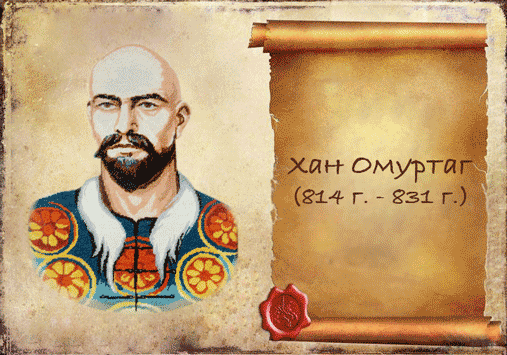
Omurtag, Krum’s son, began his rule in 814. After the war with Byzantium, Bulgarian troops were still stationed in the region of Thrace, where they defended important strategic positions.
The Byzantine emperor offered the Bulgarians peace, but they rejected it. The Romans immediately mobilized troops and erected trenches. To avoid another conflict, Omurtag signed a 30-year peace treaty with the emperor. It was sealed with a mutual oath ceremony in Constantinople.
Omurtag later helped liberate Byzantium from usurpation, which strengthened the treaty with the empire and strengthened the authority of the state.
In addition to Omurtag’s successful diplomacy, he was incredibly skilled in administrative affairs and construction. He restored the old capital Pliska, which was burnt down in 811. New palaces, temples, towers, defensive buildings, etc. were built. A new stone wall was built around Pliska as well.
It is very important to note the presence of a large number of stone inscriptions left by Omurtag – the largest number of such inscriptions left by a Bulgarian ruler.
The rise and fall of the First Bulgarian Kingdom
After Omurtag, Prince Boris I ascended the throne. He adopted Christianity as the official religion to unite proto-Bulgarians and Slavs and to strengthen the international prestige of Bulgaria in the strong “family” of Christian states.
Around 886, Boris received in Bulgaria the exiled students of Cyril and Methodius – Clement, Nahum, and Angelarius. This is how the Glagolitic alphabet – newly created by the brothers Cyril and Methodius and the worship for the Slavs reached the Bulgarian lands.
Later, Prince Simeon I, the son of Boris I, accepted the title of king of the Bulgarians and emperor of Bulgarians and Greeks. The title of emperor was recognized by the pope, but not by the Byzantine emperor.
The time of Simeon I is called the Golden Age. Then many literary centers were built all over Bulgaria, and the country stretched over three seas!

After the death of Simeon I, the power of Bulgaria declined. During the reign of Tsar Peter I, a peace treaty was concluded with Byzantium, but after its expiration, a war broke out. In 968 Seret River5 managed to capture the capital Preslav (a notorious treasure from this period was found there during archeological excavations in 1977 ) and the entire eastern part of the Bulgarian lands.
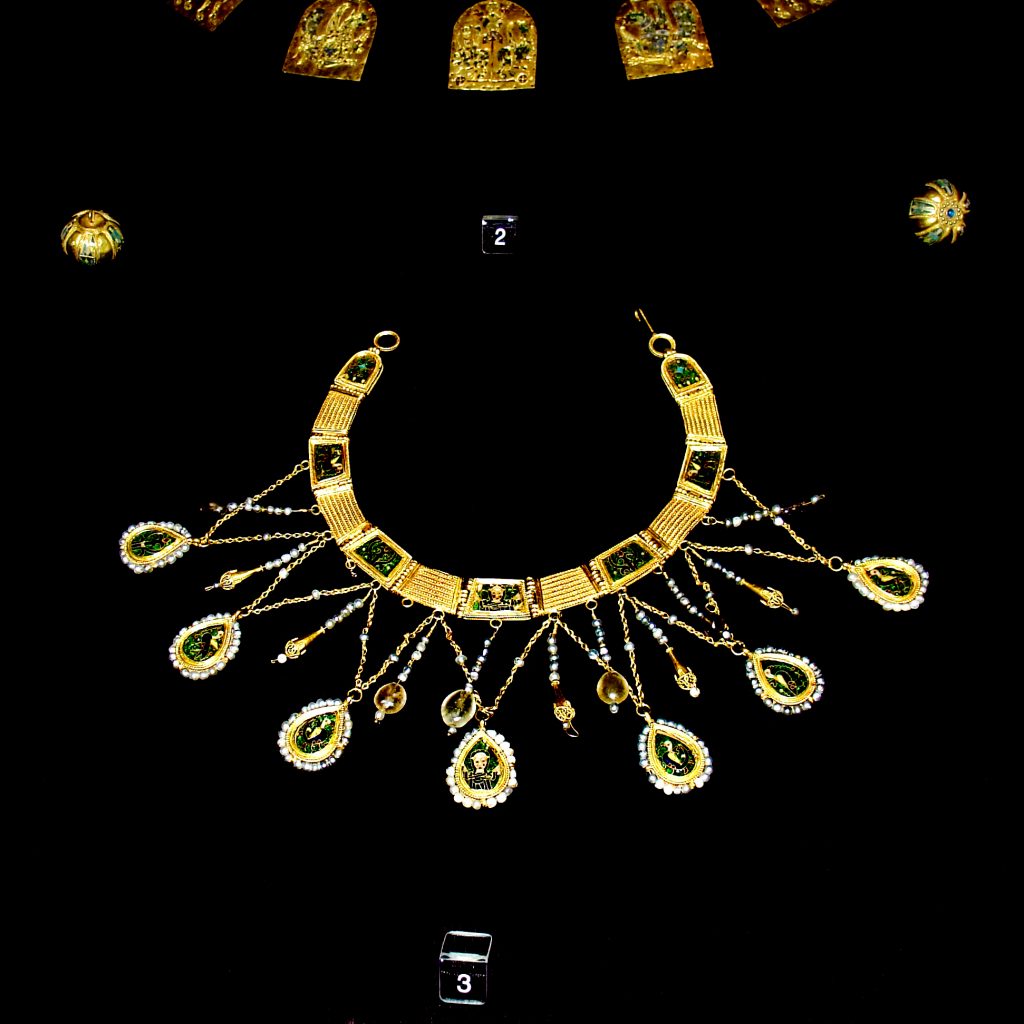
The kingdom moved the capital and after 50 years of fierce war with Byzantium, Bulgaria began to decline.
Historical Dictionary:
5. Kievan Rus was a free federation of East Slavic and Finnish peoples in Europe from the end of the 9th to the middle of the 13th century. It stretches from the White Sea in the north to the Black Sea in the south and from the main waters of the Vistula in the west to the Taman Peninsula in the east.
During the reign of King Samuel, many wars were fought, and a very heavy defeat was inflicted on the Byzantine emperor Basil II in the Battle of Trajan’s Gate6, where miraculously the emperor himself survived.
Historical Dictionary:
6. The Gate of Trajan or Trajan’s Gate is a historic mountain pass near Ihtiman, Bulgaria. It was named so after Roman Emperor Trajan, on whose order a fortress by the name of Stipon was constructed on the hill over the pass, as a symbolic border between the provinces of Thrace and Macedonia.
However, the battle near the village of Klyuch7 turned out to be fatal. Then Vasily II killed thousands and ordered 14,000 captured Bulgarian soldiers to be blinded. Because of this act, the Byzantine emperor was called a Bulgarian murderer by later writers.
Historical Dictionary:
7. Village of Klyuch is 99 km south-west from town of Blagoevgrad, 19 km in the same direction from the town of Petrich, 8 km south-east from the Bulgarian-Macedonian border at Zlatarevo checkpoint and 35 km west from the Bulgarian-Greek border at the village of Kulata.
According to legend, when King Samuel saw his blinded warriors, he died. In 1018, the last Bulgarian fortresses were conquered by Byzantium – this is the end of the First Bulgarian State.
Conclusion
At the beginning of the VIII century, the Bulgarian state emerged as an important factor in the European Southeast. It has played an important role in European history as one of the three countries that halted Arab expansion. Only Byzantium and the Frankish state in the west have made such a contribution.
Bulgaria is a mediator between the high culture of Byzantium and the Slavic world. It emerged as one of the leading political forces in Europe.
All these factors provide the basis for the long existence and development of Bulgaria, which will go through complex historical moments and will leave a lasting mark in European history.
After learning so much about the Bulgarian state, why not test your knowledge with our 5-minutes test?