

Today we want to share with you a part of Bulgarian history, a story that starts during the Warsaw Pact and ends up in Beloslav at 20 kilometers from Varna.
The hero of this story is the Bulgarian submarine Slava (Слава), which means Glory.
Тhe name of the last Bulgarian submarine sounds inappropriate and somewhat ironic. Especially considering the impending tragic fate of “Glory”, which was almost abandoned for years in Varna port.
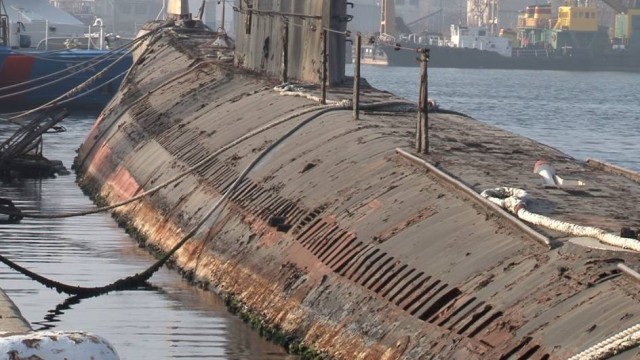
It was produced in the Soviet Union under the project “633” or NATO-class Romeo project in 1959.
It was build to be used in the Black Sea.
It was called “Lenin’s Komsomol” until 1991 when it was renamed. She joined the Bulgarian Navy in December 1985.

“Glory” is 76 m long, 7 m wide, has a draft depth of 6 m. The maximum immersion depth is 300 m. It develops a maximum speed of 15.3 knots on the surface and 13.2 knots underwater.
The Slava submarine and the decommissioned Nadezhda (Hope) submarine were never caught on the radars of NATO ships during exercises.
At the end of the 1980s, Bulgaria had 4 submarines. Let us not forget that this was the time when huge attention was paid to the naval forces within the frameworks of the Warsaw Pact.
A series of joint exercises were held with the USSR. After 1989 when the political situation in Bulgaria changed, the Bulgarian submarines started to hold exercises together with the Turkish naval forces.
After the start of the new millennium, the number of military exercises with submarines in Bulgaria decreased. The last navigation of the Slava submarine was in December 2010. The date November 1, 2011, marked the end of Bulgaria’s underwater navigation when Slava submarine was officially taken out of the Bulgarian naval fleet.

The Bulgarian Navy (Bulgarian: Военноморски сили на Република България, Voennomorski sili na Republika Balgariya) is the navy of the Republic of Bulgaria and forms part of the Bulgarian Armed Forces. It has been largely overlooked in the reforms that Bulgaria had to go through in order to comply with NATO standards, mostly because of the great expense involved and the fact that naval assaults are not considered to be a great concern for the country’s security.
Since the 18th of August 2020, The Slava submarine has been turned into a museum where visitors will have the opportunity to learn details about Bulgaria’s underwater navigation.
There are guided tours inside the Submarine, were the guide share the knowledge that was required for the sailors to been able to become submarine crew.
Also interesting stories and details about the daily life onboard a submarine.
| Displacement: | · 1,475 tons surfaced· 1,830 tons submerged |
| Length: | 76.6 m (251 ft 3 in) |
| Beam: | 6.7 m (22 ft) |
| Draught: | 5.2 m (17 ft 1 in) |
| Propulsion: | Two diesels delivering 2.94 MW (4000 shp) with two electric motors driving two shafts. |
| Speed: | · 15.3 knots surfaced· 13.2 knots submerged |
| Range: | 14,484km (9,000 miles) at 9 knots |
| Complement: | 54 men (10 officers) |
| Sensors and processing systems: | sonar and radar |
| Electronic warfare & decoys: | MRP 11-14 |
| Armament: | 8 × 533mm (21in) torpedo tubes. Six located in the bow and two in the stern. |
Admission
Adults: 12BGN, children – 6BGN (maximum visitors up to 10 people)
Opening hours:
Monday – Saturday: 9:00 – 15:00, day off: Sunday
Contact details:
Beloslav, Ferry south port
Tel.: +359 888 224 784
email: fbeloslavglass@gmail.com
You can reach the Museum of glass by:
- Intercity bus line to Beloslav center;
- Intercity bus line №14 (Varna to Devnya, intermediate stop in Beloslav). To get to the museum you need to use the ferry connection (available for pedestrians and cars).
- By train to Beloslav railway station. To get to the museum you need to use the ferry connection (available for pedestrians and cars).
You may also like:
The Son of a Bulgarian Emigrant That Changed The World
How Safe Is Bulgaria?
Cost of Living In The 3 Biggest Bulgarian Cities in 2020
If you enjoy the post, share it, and Follow us on Facebook!