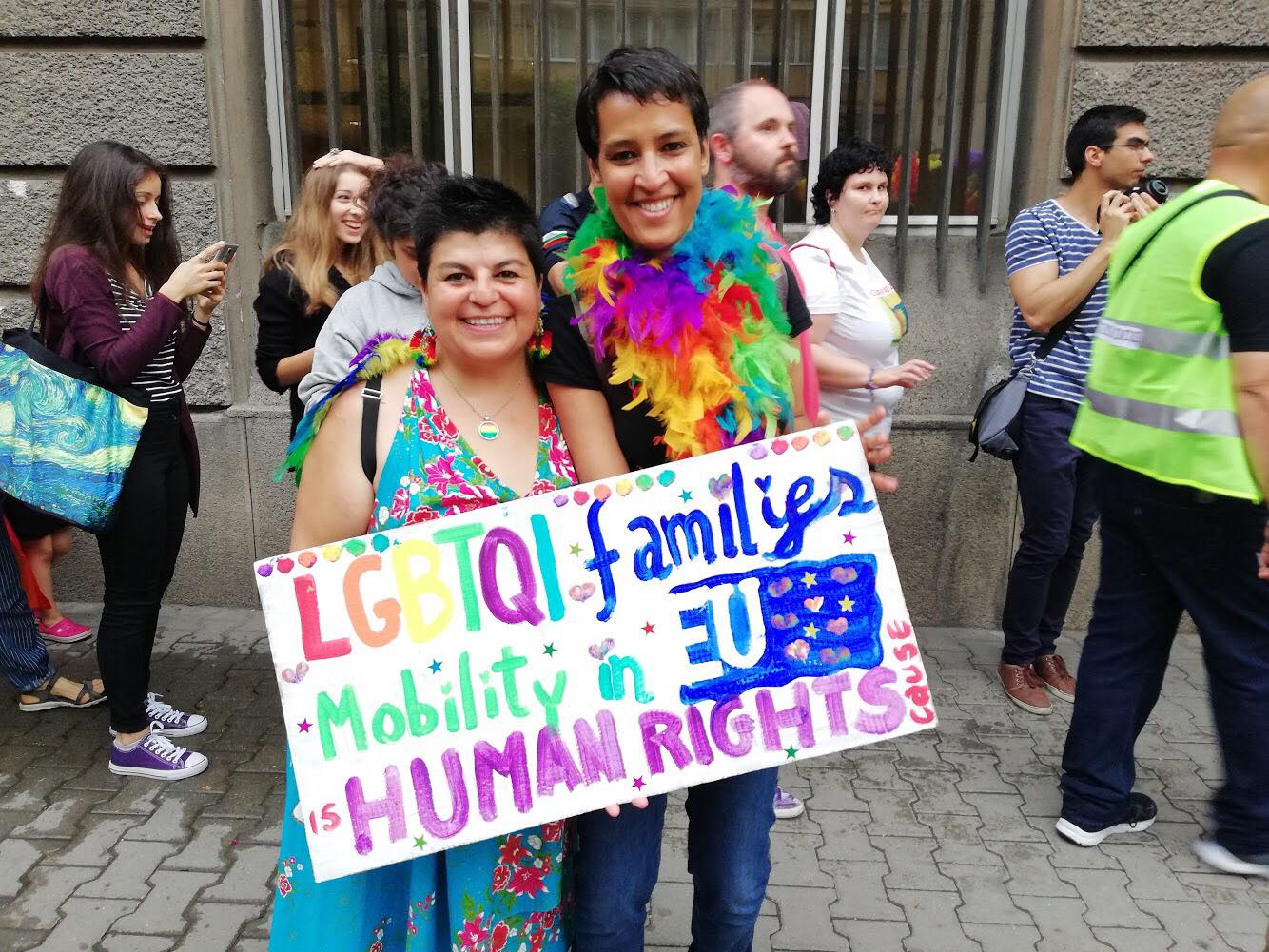
Today we are happy to have the opportunity to share with all of you in Expats Stories the interview with our dear friend Cristina, who came to Bulgaria without knowing that the peaceful life she was looking for, soon took a turn, and she was in need of defending her rights and without wanting it, she and her wife become an example for many others in Bulgaria.
Name and nationality:
Cristina Palma, Australian-Chilean
Tell us a bit about you, and what do you do?
My name is Cristina Palma, I have lived and worked around the world for the last thirty years of my life. I have worked in many organizations and companies, as community development worker, radio journalist, social researcher, business and creative life coach and lately I am exploring the world of selling for an exciting company in Bulgaria.
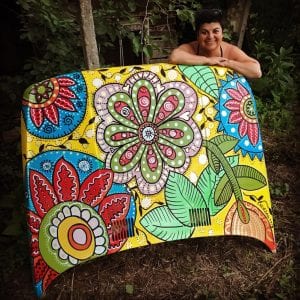
I am also a writer, started intuitive painting for the last couple of years and I do want to have a big studio built out of cob in the countryside of Bulgaria. I am gay and married to a beautiful French woman.
Why and when did you come to Bulgaria?
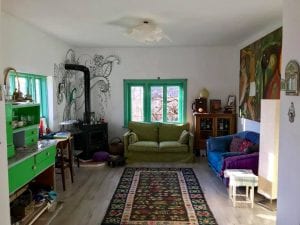
I had my first encounter with Bulgaria almost five years ago, while living in Bucharest, Romania. I visited an eco-farm B&B in the Targovishte region and after visiting seven times, we decided to buy our own country house in the same village where the B&B is: Palamartsa. It wasn’t love at first sight but rather a long flirting dance, while experiencing quietness and nature in this region where eventually we found our place.
Little by little I fell in love with the place and two years ago I came to live on my own to the country house for six months. It was magical, I love the people, the peacefulness of the place, the social and cultural activities and the landscape, and it was in that moment that I decided I wanted to move permanently to Bulgaria.
What do you like about your country?
I have been travelling a lot, but I can say that Australia and Chile are my two reference countries, which I often called “home”. I like Australia because it is a fair-go place: if you have ideas and creativity for your job, you have secured your monthly income for sure. I was never short of employment over there, and I didn’t need to have “friends” to help me to get jobs. In Australia, life experience is as important as your diplomas and I really love that since I come from a very rich life experience background.
Chile is my birth country, and I love Chile for its social movement and the creativity people come up with to overcome challenges. At home we have a say: if it is challenging and difficult, just think the “Chilean way” and you will come up with a solution! 😉
What differences do you see in your country and Bulgaria?
In fact I see a lot of similarities between Bulgaria and Chile, for instance both capitals are surrounded by mountains (Los Andes and Vitosha), people are friendly and they like to help you, just as they do in Chile. But one thing is very different, and that is the luck of participation from the civil society.
In Chile and Australia, in general there is an active civil society participation. When things are not right, thousands of people go out to the streets to manifest their disappointment. Human rights and social inequality are brought to the table very often. For instance the right to free education was a hot topic in Chile for many years until the student managed to get the government to make universities accessible to everyone whether they had the financial means or not. In Australia the right to gay marriage was fought for many years until 2017 when it was accepted in the government, but thousands of people went out to the streets for many years before the positive result was out.
My impression is that in Bulgaria there is a much smaller civil society movement; lots of fear, but lots of false expectations that someone else will come and save the situation. What really surprised me recently was the very little participation of people when the Bulgarian government did not ratify the Istanbul Convention, implying that violence against women was allowed. It was in the beginning of August, and everyone, including activists, were on holidays. Even though I have seen changes in the Bulgarian society in the years – I am very optimistic about the future of Bulgaria – I consider the civil society movement very incipient.
What do you like about Bulgaria?
Many things; the landscape is beautiful, you have everything, mountain, sea, country, city, rivers and it has a rich historical and cultural background. I love people in Bulgaria, they are overall generous and friendly and I find, particularly, the new generation very creative. I have a lot of compassion for the older generation, they have gone through so much and they also know so much, I just wish they were more valued by their country. There is a wave of artists in Bulgaria which I really love and I get the chance to enjoy it in Sofia.
What have been the document/procedure most difficult for you in Bulgaria?
Well, most procedures are relatively easy when I compared to those in France where I was living before. Even if you have to pay a lawyer and a notary, prices are very reasonable for a foreigner. But the difficulty has been when I applied for a residency visa in Bulgaria, as a family member in a gay couple.
I am married to a French women, therefore under EU Directive 2004/38/EC I am entitled to residency in Bulgaria. Bulgaria is part of the EU and they have the moral obligation to recognise the rights of EU citizens, which is the case of my wife. We are legally married, have been together for 14 years; we have the right to stay together as a family in Bulgaria or any other country under EU law, like any other heterosexual couple. So the first year I applied I was recognised of this right and I was very proud of staying in Bulgaria.
However, the second year, while renewing my residency card, I was denied the right to residency, based on the arguments that Bulgaria does only allow marriage between two people of the opposite sex. While this is true in their Constitution, we are not applying under the Bulgarian law, but under the EU legislation, specifically Directive 2004/38/EC. Unfortunately the legal system in Bulgaria is arbitrary and they have retaliated against our courage to speak up for our rights by holding a resolution in the Supreme court until May 2019, even though we have won the case already in the Sofia Administrative court.
Mention one important experience you’ve had in Bulgaria :
After winning our appeal for recognition of our rights in the Sofia Administrative courtand, on the 5th of July we received a positive answer saying that under Directive 2004/38/EC I was entitled to receive my residency in Bulgaria. Indirectly the Bulgarian government was recognising our marriage and this was a very important stamp on civil rights matters in the country.
Supported by a local LGBT organization we launched a press release to share the good news to the country. The experience was amazing, because we realised that most people, particularly the new generation, were ready to accept homosexual couples in their country. Since we were on TV and national radio, people recognised us on the streets and sometimes stopped us to congratulate our courage to show our relationship publicly.
In the village where we have our country house, the mayor spoke supportively about us being gay and be part of the village community. Our neighbour from the local shop gave us twelve eggs from her own chicken as a token of empathy.
All these were signs of hope to me and my wife and we were thankful to all the support we received from friends and the LGBT community, as well as the person on the street, in the restaurant and other public places who approached us with a gesture of kindness and support.
Do you speak other languages?
Yes. French and Spanish, and currently learning Bulgarian 🙂
Have you visited other countries?
Many; Tanzania, Ethiopia, Ghana, Djibouti, RDC, India, Guatemala and Bolivia, plus many other countries in Europe. We have lived in nine countries in the last fourteen years 😉
How is your business going?
I work as a Sales consultant for a Bulgarian company and I love it! I love the company, my colleagues and how the Bulgarian business is projecting on the international market. It is a dynamic and innovative company, I could not be in a better place right now.
What advice would you give to other people who would like to come to live in Bulgaria?
Bulgaria is a peaceful place, even though there is much going on internally. Somehow its people have created a way to deal with the stress by not giving it too much importance. I would say that in Bulgaria, you can always say: “there is always a way”.
Learning the language is hard, but there are many ways to stay informed and find help especially at the beginning. And in Sofia, you will find many young people and businesses who would willingly talk in English to you.
If you have children, my only advice would be that options in the countryside are limited, especially if you have adolescents. It may be hard for them to integrate, so you should consider to live in Sofia for that.
This is the moment to invest in real estate, and if you have a company this is the time, since taxes are still the lowest in Europe. But don’t expect to find the same you may have in well established “democratic” countries, especially if you are coming from more financially prosperous places. However, Bulgaria is developing fast and many companies are settling here for that reason.
If you are someone who love nature, and who have an outrageous dream in mind, like an eco house in the mountains, this is certainly the place to be. And if the winter is too cold for you, Bulgaria is two hours away from Greece where the sun shines for longer periods, even during the winter.