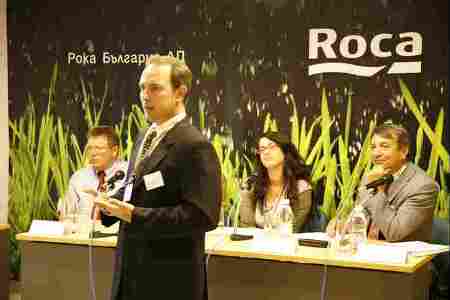
The idea of this section is share experiences form people from around the world that live in Bulgaria, and we start with my friend Demetrio.
Name and nationality:
Demetrio Alejandro Kokalj, Argentine and Slovenian nationality.
Why and when did you come to Bulgaria?
The first time I visited Bulgaria was at the end of 2004 for work reasons.
What do you like about your country?
When you refer to my country, I assume it is Argentina. From Argentina I like the warmth of the people, the weather, the food and the opportunities. It is a country that offers huge variety of services.
What differences do you see in your country and Bulgaria?
The differences that I notice are basically:
- culture, Bulgaria preserves a cultural tradition of centuries that we don’t have in Argentina (the little native culture that had in Argentina practically disappeared). Today in Argentina there are immigrants or children of immigrants from different countries of Europe and the East, which makes for a melting pot of races and cultures (when I refer to Argentina I speak basically of Buenos Aires).
- People, although in Bulgaria people are very cordial and attentive, I get the impression that in Argentina people are a bit more spontaneous.
- Security, a great advantage of all European countries, including Bulgaria is the level of security. Both Argentina and most of the South American countries suffer from high crime rates which does not make them safe and comfortable to live. Security greatly improves the quality of life, because in an insecure country one has to be constantly aware of everything that happens around him which is very stressful.
What do you like about Bulgaria?
From Bulgaria I like people very much, the way they maintain their traditions, the nature (it’s a country with a lot of variety and diversity in a few km2), its beaches and mountains, the safety and tranquility and its fruits and vegetables.
Mention one important experience you’ve had in Bulgaria
When we arrived in Bulgaria, everything was strange and it was difficult for us to get used to the system in general, especially the medical system. During the first months of our stay, we met a doctor who was finalizing his practice to graduate. For many years and despite the fact that his specialty was totally different from that of the general doctor, he was attending the whole family. It was common that he did not ask for remuneration for the consultations. Finally, he helped us get a family doctor for the whole family.
Although the medical system has many shortcomings due to lack of budget, it is endowed with excellent professionals and people who are always willing to help. You have to have some luck and find the right people.
Do you speak other languages?
My native languages are Castillian (what is commonly called Spanish) and Slovenian. I have a fluent command of the Bulgarian and English languages.
Have you visited other countries?
If besides living in Argentina I have lived in Slovenia and I have visited all the countries of Western Europe, Central Europe and some Eastern European countries. I have also visited countries in Asia, the Caribbean, Central America and North America.
What advice would you give to other people who would like to come to Bulgaria?
It is a very generic question because they can come as tourists or with the intention of permanent residence.
In general it is good to have basic knowledge of the language, be interested in the medical system to know where to go in case of emergency and know that you can not count on much with the help of law enforcement.
Public employees (basically municipal bureocrats or police agents) still have a hard time being kind.
The doctors and their corresponding work teams in general are eficients.
Another interesting thing to keep in mind is the gesticulation that is made with the head to affirm or deny something, because these codes in Bulgaria are different (practically opposed) to the vast majority of countries.
Do not forget the lack of a coherent signaling system. In the event that a vehicle is driven, it is common to run into old signs that should no longer be, incorrect signs and both streets and sidewalks in a poor state of conservation.