
If you want to get your driver’s license in Bulgaria you will need the right information, and the right person to provide this kind of information in Bulgaria are the professional driving instructors.
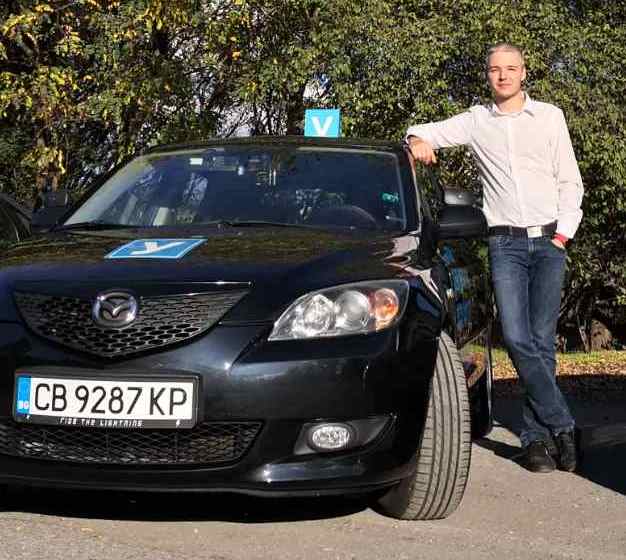
And today our friend, the instructor Andrey Popov has prepared all information you need to know to obtain or exchange your Driver’s License in Bulgaria in 2021.
In today’s world of fast-growing and progressive life, the freedom of action is a need most strongly manifested in the big city. Here we are forced to be quick, communicative, and useful to society and in particular our friends, relatives, and even increase your employability.
This is my mission as a driving instructor – to help you and your loved ones feel the freedom that comes with your driving license.
The requirements
Let’s start with the requirements for obtaining a driving license in Bulgaria. They are mandatory if you want to get a license for the first time or if you want to replace your non-EU license with a Bulgarian one.
The first requirement is to have a residence permit (an ID card) – you have to be a legal resident in the country.
In Bulgaria, there is also a requirement for minimal education level of at least the 10th grade of high school completed in order to be allowed to have a driving license. The document which certifies that you cover the minimal education level is called an education certificate.
You can apply for the education certificate either with your high school diploma or your university degree. So, what’s the difference?
The 1st option (high school diploma) takes 30 days and costs 35 lv.
The 2nd option (university degree) could take up to 2 months (depending on the country where the document is issued) and it’s free.
Let me guide you through the process of applying for the education certificate. As you know sometimes the bureaucratic procedures might be a bit annoying, but the following guidelines will help you go through them much easier:
Education certificate issued based on your high school diploma (the document is called Uverenie/Уверение):

You need to have your high school diploma together with the transcript (the document that shows your grades and subjects).
Depending on the country of issuing of the diploma you might need to get it apostilled. The apostille is a special type of attestation which you can usually obtain from the ministry of foreign affairs of the country where the diploma is issued. Some countries DO NOT need to have it apostilled, and those countries are: Austria, Azerbaijan, Albania, Algeria, Armenia, Belarus, Vietnam, Georgia, Greece, Spain, Italy, Yemen, Cyprus, China, North Korea, Cuba, Kuwait, Libya, Lebanon, North Macedonia, Mongolia, Poland, Romania, Russia, Syria, Uzbekistan, Ukraine, Hungary, France, Czech Republic, Slovakia, Serbia, Bosnia and Herzegovina, Croatia, Montenegro, and Slovenia.
Then you need to make a notarized translation (by a sworn translator) of your high school diploma and the transcript (you may use any company offering legalized translations).
The final step is to take your original diploma and transcript together with the translation and your ID card (and a copy) to the Regional Education Management Department (РУО София) or the city where you have your residency where you apply for your education certificate. Note that you need to fill in an application form which could be downloaded from the following link
The address of the Regional Education Management Department is room 401 on the 4th floor at 17th “Antim I” Str., Sofia, working from 8:30 to 17:30:
There is a tax of 35 BGN which could be paid via POS terminal (if your card is issued by a bank in Bulgaria) or via bank transfer at IBAN: BG57UBBS80023106075808.
Personal advice: It’s good to have someone speaking Bulgarian to accompany you as the local Education Department employees don’t speak English
Education certificate based on your university degree (the document is called Udostoverenie/Удостоверение):

You need to have your university degree together with the transcript (the document that shows your grades and subjects).
Depending on the country of issuing of the degree you might need to get it apostilled. Usually, it is quite hard timewize and moneywize to aquire an apostile (as it includes sending the document abroad) and that’s why it is important to know exactly if you actually need it or not. Apostile is NOT needed if:
Your university degree is issued in a country- party to the Lisbon Recognition Convention, or in a member-state of the European Union, Iceland, Liechtenstein, Norway or Switzerland.
Your university degree is issued in a country which has a bilateral agreement for legal assistance with Bulgaria (so-called consular certification).
So, how to check if your university degree needs an apostille?
Open the link below and click on “WHAT LEGALIZATIONS AND CERTIFICATIONS ARE NECESSARY” (point 3 located at the right side)
Then you need to make a translation (by a sworn translator) of your university degree and the transcript (you may use any company offering legalized translations).
Note that you DON’T need to have your translation legalized (notarized) if your university degree is issued in a country- party to the Lisbon Recognition Convention, or in a member-state of the European Union, Iceland, Liechtenstein, Norway or Switzerland (the full list of countries is available at the link above).
The university degree only needs to be translated by a sworn translator. The notarization procedure makes the translation service more expensive and, in some cases, it takes more time.
The final step is to take your original degree and transcript together with the translation to the National Center for Information and documentation (NACID) where you apply for your education certificate (issued via academic recognition). Note that you need to fill in an application form which could be downloaded from the following link:
The address of NACID is 52A, Dr. G.M. Dimitrov Blvd., Sofia working from 8:00 to 18:30:
The driving course in Bulgaria
After you’ve acquired your education certificate it’s time to start with the driving course.
The full driving course consists of the theoretical and practical parts, each ending with an exam. It takes between 1,5 to 2 months depending on your individual pace and availability.
The theoretical part consists of both face-to-face and online classes in English which cover all aspects of the road traffic rules and their application in Bulgaria.

Note that you’ll be provided with an online textbook in English which I’ve created specifically for the foreigners in Bulgaria which proves to be of great help during the learning process. The textbook covers the Bulgarian road traffic rules and includes lots of examples and pictures. You’ll also receive the full database of exam questions and answers which will be thoroughly discussed during our meetings.
The full database of exam questions and answers can be accessed at the following link
You can do a practice test at the following link
The practical part consists of at least 31 driving hours (50 min each) divided into 16 sessions/2 hours per session) delivered in English. It covers all aspects and principles of defensive driving including the practice of safe road habits, obeying the rules of the road, driving responsibly, and minimizing the risks.
We have full flexibility in scheduling the driving classes including before or after working hours and the weekends as well.
We will start in an area with low traffic intensity and gradually based on your progress we’ll switch to areas with more intense traffic (e.g., the city center). Each driving class will take you a little bit out of your comfort zone which guarantees the best learning results. The practical course also includes out of city driving covering motorways and mountain roads as well as driving during the dark part of the day.
You will also have the ability to fully observe your learning progress via the dual lens camera in the car which captures not only the situations on the road but also your own reactions. The recordings are available as per your demand. Sometimes the stressful situations in the traffic prove to be quite a useful lesson.
The Driving exam In Bulgaria
After the theoretical part of the course, you have to take the theory exam which is a test of 45 questions with a time limit of 40 minutes. Depending on the difficulty each exam question gives you 1, 2 or 3 points. You need to have at least 87 out of maximum 97 points in order to successfully pass. The exam is being scheduled by your driving school (as per your workdays availability) and takes place at 1st Vitinya Str., Sofia (The Executive Agency Road Transport Administration).

After the driving classes you have to take the practical exam which consists of 25 minutes driving with a state examiner. He sits on the passenger seat and gives you the directions for movement. The examiner evaluates your driving technique and knowledge of the traffic rules. Each mistake gives you different penalty points depending on the severity. You are allowed to have no more than 9 penalty points. At the end, the examiner analyses your mistakes and provides an explanation. Note that the exam is being video recorded.
As per the Bulgarian legal regulations the practical exam is being conducted in Bulgarian language, but during your driving course you’ll be provided with a special workbook covering the Bulgarian pronunciation (including audio recordings) and transcription of the most commonly used directions during your exam (e.g., turn left, turn right, U-turn, etc.) which will also be practiced during the driving classes.
Replacing a non-EU driving license
All foreigners are allowed to drive in Bulgaria with a non-EU driving license (provided that it has a legalized/notarized translation) for up to 1 year since the date of issuing of their residence permit. Then the non-EU license needs to be replaced by a Bulgarian driving license. This is also valid for the international driving permits as well.
You are allowed to replace your non-EU license with Bulgarian license without the obligation to take the full driving course, but you have to take the exams (theoretical and practical).
For the foreigners who want to replace a non-EU license with a Bulgarian one, I’m providing a smart, quick, and easy solution that includes:
- Preparation for the theoretical exam including a textbook in English, the full database of exam questions and answers and online scheduled discussions where we cover and discuss the problematic topics and questions.
- Preparation for the practical exam including 4 driving hours in the exam area to get yourself familiar with the car and the tricky parts of the area itself. This takes into consideration that you can actually drive (car with manual gearbox), but if you prefer you can always take additional driving hours as well.
- The price
The price of the full driving course is 1120 BGN in total including all exam taxes (disclaimer note: prices could be subject to a change, depending on the prices of the fuel and insurances).
The price of the exam preparation course for replacing a non-EU license with Bulgarian license is 400 BGN in total (including all exam taxes);
In case you want to take additional driving hours – the price is 30 BGN per hour (50 mins).
In the case of an unsuccessful exam (for both theoretical and practical exam), there is a fee of 60 BGN per each additional exam attempt. Note that you are legally obliged to take a minimum of 4 driving hours in case of an unsuccessful driving exam.
Applying for the driving license at the traffic police office (KAT)
3 working days after you take your exams you can apply for your driving license at the traffic police office (KAT) located at 4th Lachezar Stanchev Street, Sofia working from 7:30 to 17:00.
Upon applying for your driving license you need to present the following documents:
Your ID card
Your education certificate
Medical certificate for vehicle of category B (it can be obtained by almost any medical center). The tax is between 30 and 40 BGN (depending on the medical center).
First aid course certificate.
It is being issued based on a training course at the Red Cross office located at 61th Knyaz Alexander Dondukov Blvd., Sofia. The courses are being conducted every day (except Sunday) and can be scheduled online.
Note that the courses are held only in Bulgarian, but you’ll be provided with written materials and a final test in English (valid only for the Sofia Red Cross office). The tax is 60 BGN.
Also, if you already have a certificate issued by any Red Cross instance (no matter the country) – it could be accepted which means that you won’t have to attend any first aid course. You just need to email your certificate to secretariat@redcross.bg and after you receive feedback – you need to visit the Red Cross office where you’ll be issued with an additional renewed certificate. This still includes paying the tax.
In case you’re replacing a non-EU license with a Bulgarian license – you need to present your foreign driving license.
Declaration confirming legal residency in the country. It can be downloaded at the following link
Note that you need to have at least 1 copy of each document listed above.
The tax for issuing a driving license is 27 BGN for normal service (30 days) and 52 BGN for fast service (10 days).
Feel free to contact me
Of course, I can personally assist you with every aspect of the process for obtaining your driving license. This includes visiting the different institutions, help and advise with the paperwork, and interactions with the local state representatives.
Yes, there will no longer be the distance limitation or the inconvenience of waiting at the bus stops during the cold winter months.
The right to be a driver also carries its responsibilities, which you will safely build up after each driving class. So don’t hesitate and don’t allow unnecessary dilemmas to disturb your wonderful world – just make it even more magnificent and free.
Andrey Popov
Mobile/Viber/WhatsApp: +359 879 348 177
https://www.facebook.com/DrivingInstructorAndreyPopov
e-mail: andrey.popov1989@gmail.com
Driving School Demo Moto EOOD
Address: 150 Vasil Levski Blvd., Sofia: