
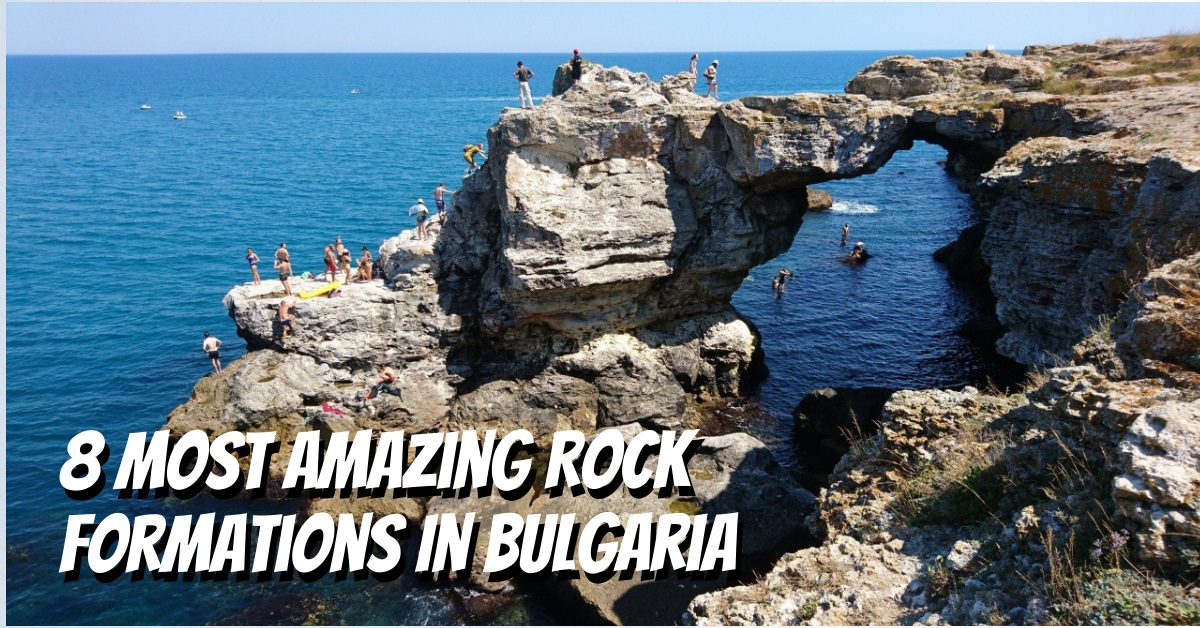
Everybody that has visited Bulgaria can appreciate that has a great variety of topographical features and diverse landscape ranging from peaks in Rila, Pirin and the Balkan Mountains to the mild and sunny Black Sea coast
The diverse morphological, climatic, and hydrological conditions of Bulgariafavor the formation of a large number of geological features.
And today we want to present 8 of the most interesting ones that are open and we can visit them.
Then when you have a chance and you are driving around Bulgaria, don’t forget to visit any of these magnificent natural wonders.
1- Devetashkata Cave
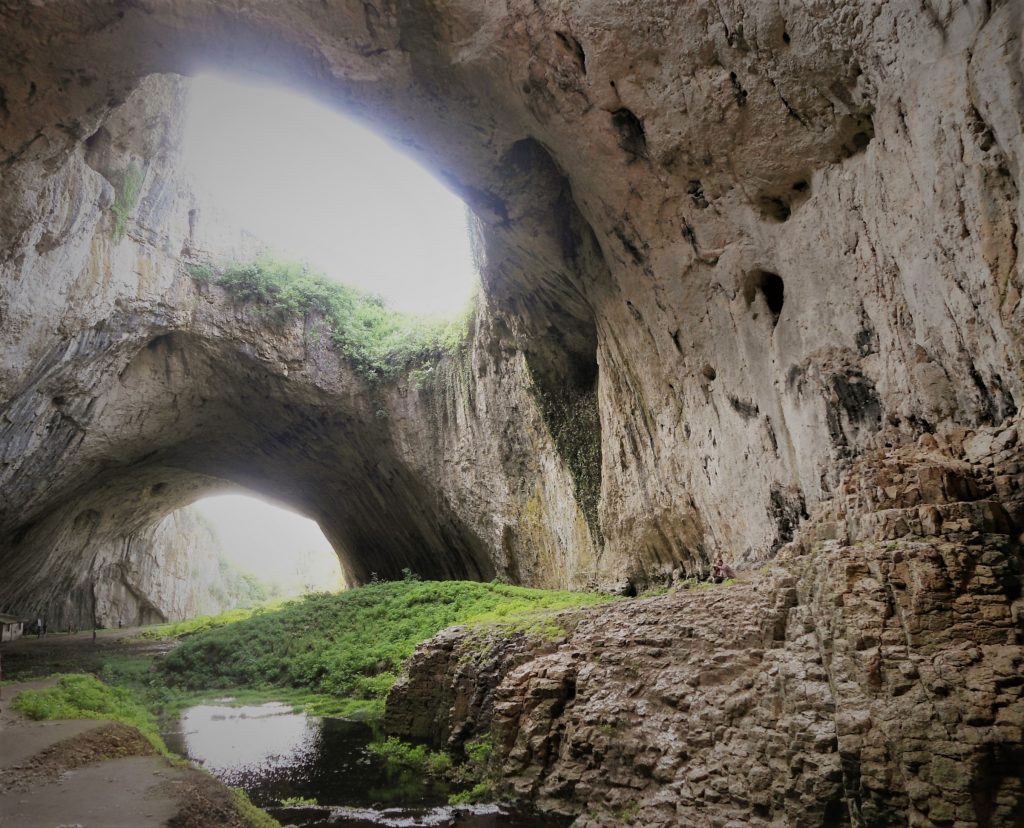
Located about 20 km from the town of Lovech. and from the entrance of the place, is an easy walk crossing the Osam river on the bridge that was built, as a donation, for the filming of the movie “The Expendables 2” in 2010.
The entry hall is huge, probably more than 50 m in height, with 7 scattered openings on its ceiling. A streamlet, coming from one of the two galleries of the cave, flows through the hall and then meets with the Osam river.
There are 15 kinds of bats and several other protected species of birds, mammals and amphibians living in the cave and the two galleries are closed for visitors from the beginning of November till the end of March during the bats’ breeding period.
In the 20th century during the communist regime in Bulgaria, the cave was used as a petrol warehouse by the military but the tanks were removed at the beginning of the 21st century.
Most of the tourists are local people, which makes the visit even more interesting, far from massive tourism, and close by is the famous God’s eyes cave (Prohodna cave).
2- Tyulenovo Rocks
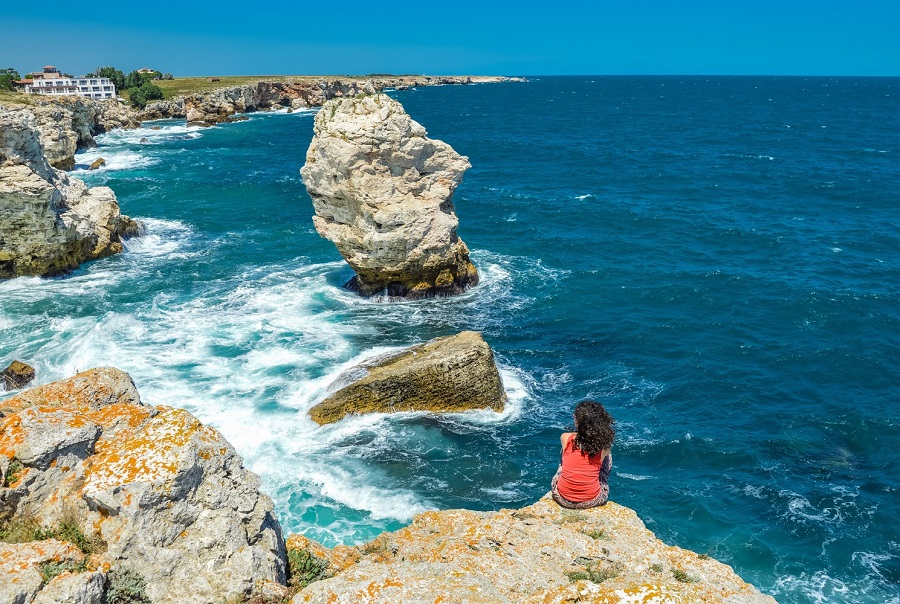
This is truly a must-see place. The view is incredible and the sense of freedom it gives you.
Beautiful views, high cliffs, caves, birds and sea life. The smell of the sea and the slashes of the waves against the rocks complete the view offered by this place. You cand climb the rocks, but you must be very careful and be well prepared with the right shoes.
Dolphins can be seen from the coast and they usually come nearer to the land in the early morning or late afternoon. The caves in the cliffs were used as dwellings, and nowadays backpackers set up camp inside for free accommodation. There is also a great sand beach in Bolata, less than 25 kilometers from Tyulenovo.
3- The Wonderful Rocks
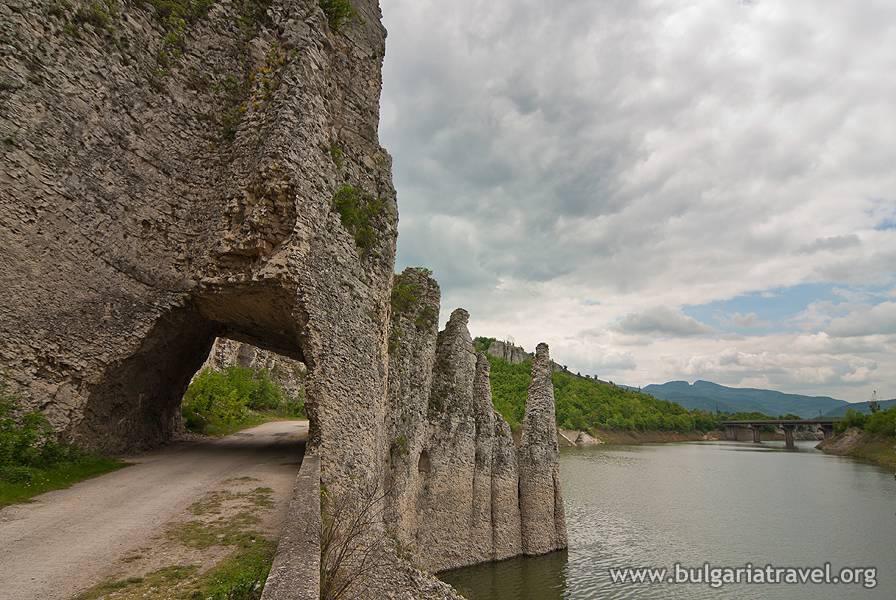
The Wonderful Rocks is a massif consisting of about ten beautiful rock needles, 40-50 meters high, shaped like castle towers. They were formed by the effect of water and wind on limestone. The rocks had formed directly by the banks of Tsonevo dam, where they are steepest and vertical.
The phenomenon consists of three massifs. Three tunnels are dug through along their entire length, where an automobile road made of crushed stones passes. Since they can be seen from the main road, the rocks often attract travelers, which come by to enjoy the view.
A lot of interesting caves, rock massifs and holes, some of which are inhabited by large rapacious birds are situated in the region.
The rocks which have routes for rock climbing are also interesting. They are situated at a distance of 10 minutes walking from the natural phenomenon “The Wonderful Rocks”, uphill along a steep path, at the place of an abandoned quarry. The rocks have the shape of an arch, with a typical ceiling in their upper part.
4- The Stone Forest
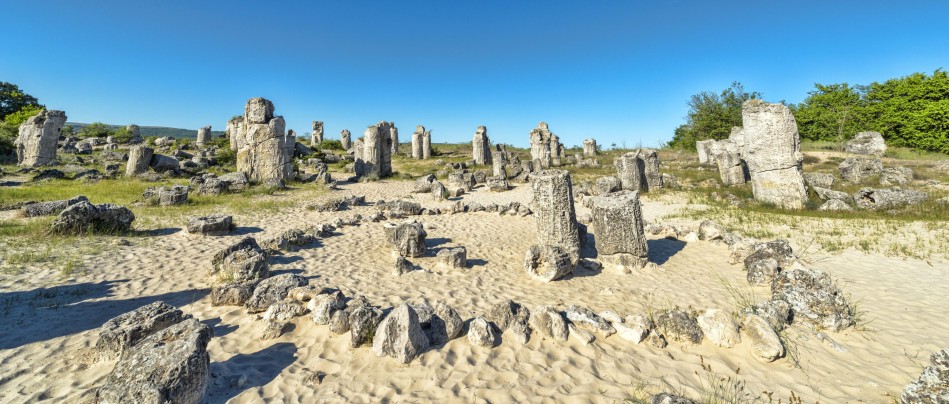
The natural landmark consists of an ensemble of stone columns, up to 10 meters high, hollow or thick cylinders, crossed cones, variously shaped and sized rock blocks and multiple stone pieces spilled around the entire complex.
The Pobiti Kamani had been famous as a sacral place since antiquity, but they were documented for the first time in 1829.
The ensemble “Dikilitash Group” is the most famous and attractive for the tourists. It is situated at about 18 km west from Varna and is easily accessible from Route Е70. The complex consists of more than 300 different in size columns, situated in a stripe with sizes 850 meters x 120 meters, and about 50 structures are situated in a smaller area to the south. Some of the columns are broken in two or three parts, others are lying on the ground as if they had been uprooted from their places, and others form interesting sculpture groups.
5- Beglik Tash
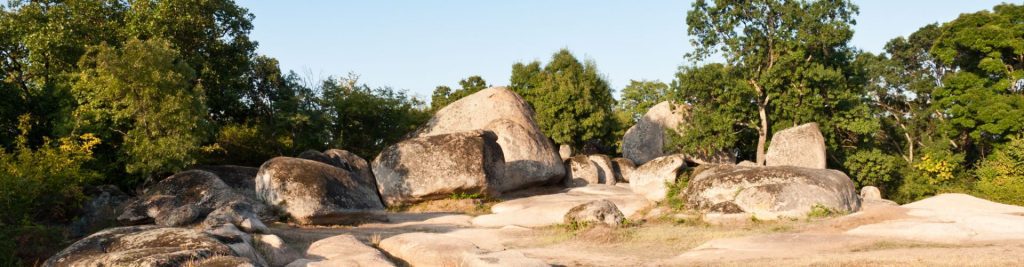
The place is full of natural splendor and is called “Bulgarian Stonehenge”. The stones are very impressive and it’s easy to imagine ancient people there.
Is a prehistoric rock sanctuary situated on the southern Black Sea coast of Bulgaria, a few kilometers north of the city of Primorsko. It was re-used by the Thracian tribes in the Iron Age.
Most of the megaliths have traces of carvings for the purposes of Thracian rituals. There are also the remains of a labyrinth that visitors can pass through. A Thracian sun-clock is formed from huge stones. There is also a 150-ton rock that rests on the ground in only two places, and a “womb-cave”.
Archaeologists have found ceramic artifacts from the Early Iron Age (10th–6th century BC), classical antiquity, and the Middle Ages, as well as a man-made stone altar at the end of the natural cave which proves that it was used as a place of worship. Every day at noon, a ray of sunlight enters the narrow entrance of the cave and projects itself on the back of the cave.
According to the Bulgarian archaeologist Alexander Fol some of the Thracian womb-caves had the property of letting the sunlight in only at certain times of the day, a natural phenomenon seen by the Thracians as acts of symbolic fertilization of the Earth womb or the Mother Goddess by the sun phallus of the Sun God
6- Belogradchik Rocks

Is a group of strangely shaped sandstone and conglomerate rock formations located on the western slopes of the Balkan Mountains (Stara Planina) near the town of Belogradchik in northwest Bulgaria. The rocks vary in color from primarily red to yellow; some of the rocks reach up to 200 m in height. Many rocks have fantastic shapes and are associated with interesting legends.
They are often named for people or objects they are thought to resemble. The Belogradchik Rocks have been declared a Natural Landmark by the Bulgarian government and are a major tourist attraction in the region.
7- Marvelous Bridges or Wonderful Bridges
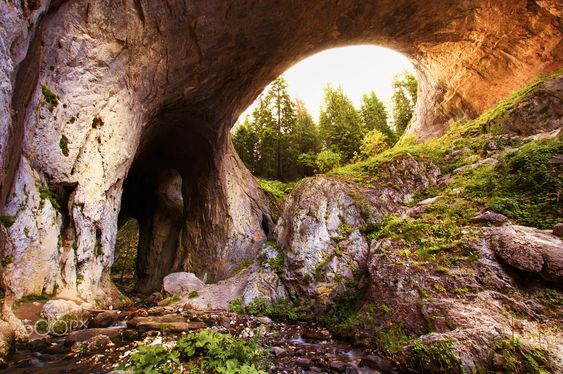
The “bridges’ ‘ were formed by the erosive activity of the once larger Erkyupryia River. It transformed the marble clefts into a deep-water cave, the ceiling of which eroded through time and collapsed, possibly during an earthquake. Geologists suggest that the water carried the debris away.
As a result, the two remaining bridge-shaped outcrops remained. The larger one (upstream) is 15 meters at its widest and 96 meters long, and shaped by three vaulted arches, the largest of which is 45 meters high and 40 meters wide. The river flows under the middle-sized arch.
The larger Wonderful Bridge is passable under the vaults, where birds nest in the marble clefts. The smaller bridge is 200 meters downstream. It is impassable to tourists, 60 meters in length, with a total height of 50 meters, 30 meters at the highest point of the arch. A third, small and inaccessible, formation follows, the entrance to a pothole where the river’s waters disappear underground, reaching a sump after 3 km.
8 – The Stone Mushrooms
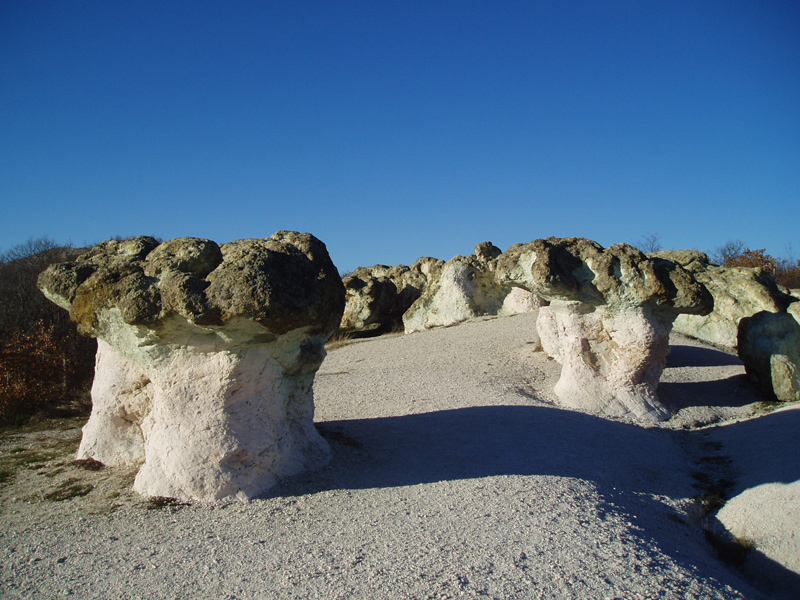
The natural phenomenon The stone mushrooms, a natural rock formation, is located near the village of Beli plast, Kardzhali municipality. According to legend, the stone mushrooms are the four beautiful daughters of a local coal miner, captured by a horde of invaders and visited by them as they attempt to escape.